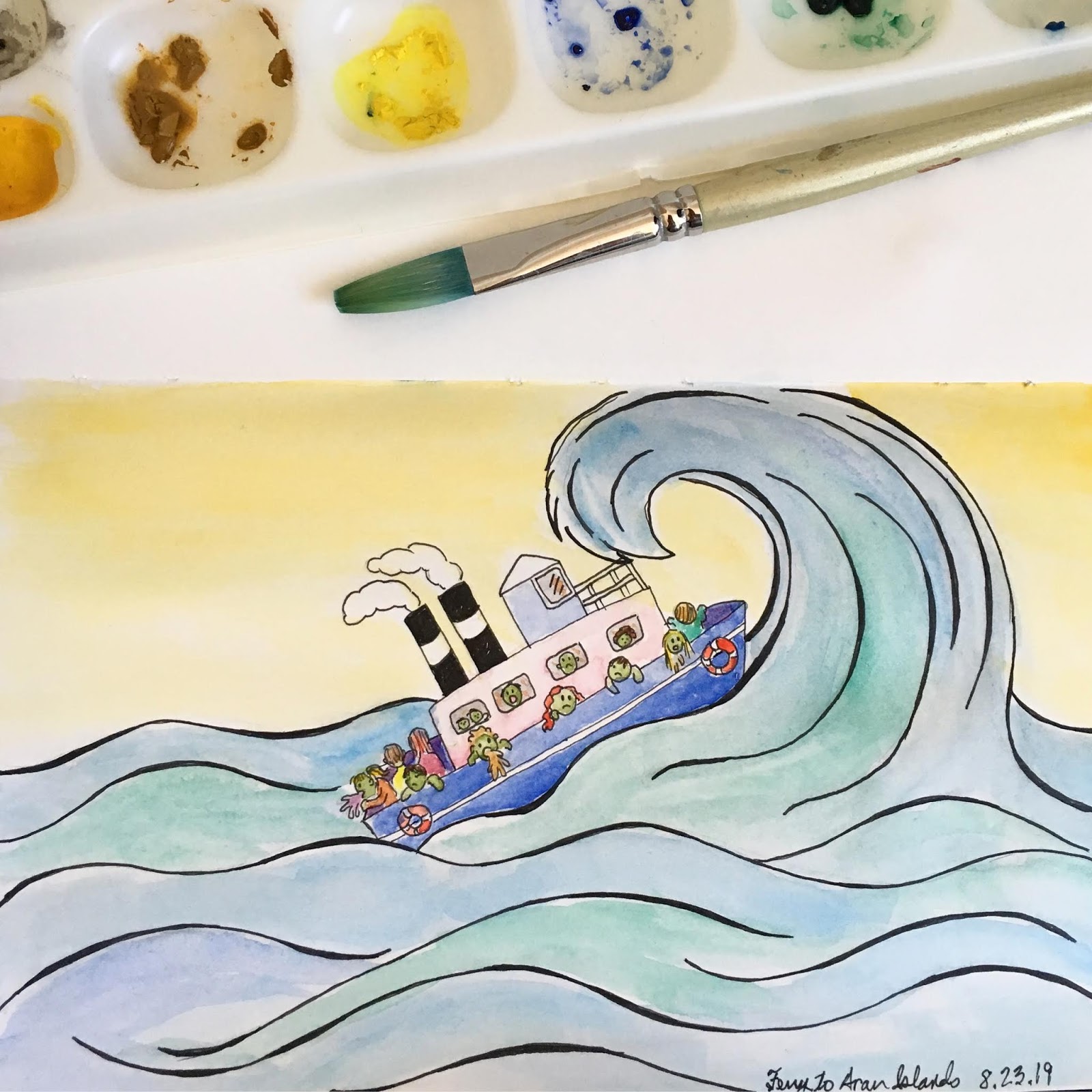
Last year I wrote about our trip to Ireland. It was my 2nd all-time most popular post. If you're now wondering what post could top Ireland, my #1 post of all time is
Walkin' in Memphis, where I took my first of what would become three trips to Tennessee and the world-famous Graceland. So now we know that the only thing that can top Ireland is Elvis. Not even a country can compete with the King.
We visited some new places that we hadn't been to before so I won't repeat any museums from last year's post. You can
click here to read all about it. However, I have not written a post about one of my previous trips which was to Northern Ireland so I will just quickly recommend some of my favorite places.
The first would be Belfast. I took a day trip to Belfast and enjoyed it so much that I took another day trip the following day. It is a very user-friendly city and I was able to go alone and not get lost and I tend to get lost very easily! I took the train and walking distance from the train station is a visitor information building where they have real live human people giving you information about things to see and do and handing out free maps. That's where I found out about the black taxi tour.
I went on the Political tour of the city where we drove around and my driver explained all of the murals, we visited the prison, the cemetery, and the Europa hotel-also known as Europe's most bombed hotel. It wasn't the most cheerful activity but I think it is important in terms of learning about Irish history. In Belfast, it's very hard to ignore the history with the murals on all of the buildings.
You can also visit the City Hall and take a tour, the Titanic Memorial, or visit many art galleries and museums.
 |
| Belfast City Hall |
Another absolute favorite of Northern Ireland was Giants Causeway. Scientists say that the 40,000 basalt columns stretching out into the ocean were formed by a volcanic eruption 60 million years ago but legend argues that it was formed two thousand years ago by a stomping giant named Finn McCool. I don't think my American vocabulary has suitable adjectives to describe Giants Causeway so for this post I'm going to steal some Irish ones. Giants Causeway was positively brilliant. Just lovely. It is located on the Northeast coast of Ireland in County Antrim about three miles northeast of the town of Bushmills.
 |
| Giants Causeway |
And of course, it wouldn't be a proper visit to Northern Ireland if I didn't take a tour of the Bushmill's Whiskey Factory. I won't lie. The best part about the tour was the free whiskey at the end.
This year we were back in County Wexford again for our niece's christening. There was much excitement going on in Wexford as the girl's Camogie team won the All Ireland Finals for the third year in a row. I think it's great that a girls sports team received so much support and television coverage. They even got a big parade. If it were America, I bet no one would even know that there was a women's Camogie team. And I'm willing to bet that my non-Irish readers are googling "Camogie" right now. Camogie is women's hurling. Don't ask me why they just don't call it women's hurling. I've asked my Irish relatives this question and no one seems to know. Now you're googling "Hurling". Hurling is an Irish sport that's sort of a cross between lacrosse, rugby, and field hockey. What it looks like to an American who's never seen it before is a bunch of lunatics wearing no padding and beating each other with sticks.

I also learned some great new Irish phrases on this trip such as "A storm in a teacup" which means "a little thing" in Irish English or "no big deal" in my American translation. I don't know why they don't just say "a little thing" but I'm going to steal this one because it makes me laugh every time. I have to admit their overly embellished version of English does sound a lot nicer. For example, when the wheels on my friend's shopping cart were buckling, instead of telling her the wheels were crooked, Darren (if this is your first time reading my blog, Darren is my Irish born and raised husband) told her "the wheels on your trolley are buckling like a baby calf's legs" or when we were in Florida, Darren said to my brother, "There's a fair amount of heat in that sun." To which my brother agreed, "Yeah. It's hot." Even his complaints about the heat sound nicer.
The other big excitement was the National Ploughing Championship which was going to be held in Wexford this year. To my extreme disappointment, the championships started the day we left. I would have really liked to see this. I had so many questions. I asked my relatives again how one wins the plowing championship. No one really seemed to know for sure but they think the plow that makes the straightest line is the winner.
We went to a couple of great new places in Wexford this year. The first was the John F. Kennedy Arboretum. After Kennedy's assassination, United States citizens of Irish origin desired to create a memorial to him in Ireland. The Irish Government suggested they create an arboretum in his honor. There is a prominent hill adjacent to the Arboretum called, Sliabh Coillte which serves as a viewing point. It provides a view of the whole Arboretum as well as six counties. 'Tis a lovely Irish view.
Ireland has less than 30 native tree species but its climate allows trees from all over the world to thrive there so the Arboretum showcases approximately 4,500 species and varieties of trees, plants, shrubs, climbing plants and woody ground clover.
The site was chosen because it allegedly lies just 5 km from Kennedy's ancestral home. The homestead is open to visitors so we followed the signs which said it was just another 3 km up the road. Then we got to another sign that said it was another 3 km away...and so on and so on. We drove for about half an hour before we found it and found a sign on the gate that said it was closed for renovations. So here are some pictures of the outside.
 |
| Kennedy Homestead |
Some other places we visited that we hadn't seen last year were Enniscorthy Castle and Vinegar Hill. Enniscorthy Castle is an ancient Norman stronghold located on Castle Hill in Enniscorthy, Wexford. Inside you can explore the development of the castle and the town over 800 years, including its role in the 1916 Rising.
 |
| Enniscorthy Castle |
We had access to the entire castle, including the dungeon where prisoners were kept as well as the roof where we could view the entire town and Vinegar Hill.
 |
| A prisoner painted this on the dungeon wall |
On display on the top floor of the castle was the work of designer Eileen Gray. This part of the museum made no sense to me. It was completely disjointed from the rest of the exhibit which was totally cohesive. It appears that they ran out of ideas for the top floor and just threw in work by Eileen Gray simply because of her connection to Enniscorthy. After learning more about her from the exhibit, I'm bothered even more when I learn that she wasn't even born in Enniscorthy, but rather "just outside" Enniscorthy. Gray was born in Ireland but her parents were Scottish. While she did spend her childhood in Ireland she actually studied in France and then spent most of her life back and forth between France and London. I mean no disrespect to Gray or her work but I just think that there is a more appropriate venue than a Norman Castle for the display of 20th Century lacquered furniture. Perhaps in the Irish Furniture exhibit at
Johnstown Castle would be a better fit.
 |
| View of Enniscorthy and Vinegar Hill from the roof of the castle |
 |
| Vinegar Hill |
Vinegar Hill was the most famous outpost during the 1798 Rebellion and a defining symbol of County Wexford. It was the site of one of the bloodiest battlefields in all of Irish history. Today it is a peaceful and serene memorial with a splendid view.
Before we left Ireland we spent the day in Dublin. I had heard so many great things about the Guinness Factory and I never got to see it on trips one, two, or three so this time it was number one on our list. I think if there's any museum that could actually rival Graceland in its grandeur and glory it would be the Guinness Storehouse in Dublin. I'm going to use my Irish adjectives again and tell you that it was brilliant, gorgeous, grand, absolutely stunning, and lovely (American English translation=Totally Awesome). I know those aren't words you'd think would come to mind when you think of a brewery but that's what it was. The biggest question I had when walking through the exhibits was how big was the budget for this museum? It appeared that endless amounts of money were poured into turning this fermentation plant into a seven-story museum.


The building is designed in the shape of a giant pint of Guinness. If it were to actually be filled it would hold 14.3 million pints. Each floor was filled with hi-tech video interactive experiences. There was very little static signage so you didn't have to pause every few paces to read about what you were looking at. The few signs they did have, were well incorporated into the design of the space and had some serious custom hardware.

I'll take you briefly through all seven floors. The lower level ground floor is where you are welcomed into the storehouse and purchase your tickets. There are some artifacts from the building's history as a fermentation house which opened in 1904. On the ground floor, a staff member will greet you and give you an introduction to the museum. Located in the heart of the museum is a copy of the famous lease signed by Arthur Guinness on December 31st, 1759. Guinness begins with four natural ingredients (barley, hops, yeast, and water) so in the ground floor displays, you will learn about how these ingredients are harvested and used.
 |
I can't think of a better way to stress the importance of water
to the Guinness recipe than a giant waterfall in the middle of the museum |
On Floor one, you will find a video interactive in which a Master Brewer will guide you through the brewing process. You will also explore various transport methods used by Guinness for centuries. In this part of the museum, you will find models of Guinness boats, planes, and trains.


Also on this floor were my two most favorite parts of the museum, the Taste Experience where you can sample the finished product and the Cooperage exhibit where you will learn about the fascinating time-honored craft of cask making. I think this was a favorite for many other visitors as well since it was the most crowded part of the entire museum aside from the pub on the top floor! There were stacks of old wooden casks piled up and inside them were monitors playing looping black and white footage of a Cooper making a cask. The entire process was painstaking and done completely by eye. It truly is an amazing skill and lost art. I wonder if the Guinness in the wooden cask tastes any different from our modern metal casks.

The second floor is dedicated to Guinness Advertising. There are rows and rows of displays with old Guinness bottles, labels and advertisements, including the very first advertisement which appeared in the national British press in 1929 with the slogan, "Guinness is Good for you." I also learned about the history of the Guinness Book of World Records and that it was created in a pub to solve disputes about facts. Now that is a fact I did not know!
On the third floor, you can use a computer kiosk to trace your Guinness roots and find out if any of your family members ever worked in the Guinness Brewery and what role they might have played. Other kiosks give quizzes about your "Drink IQ" where you can learn about socially responsible drinking. Then there is another room in which you can learn about all of the sporting and music events sponsored by Guinness.
On the fourth floor, you can attend the Guinness Academy and learn how to pour the perfect pint of Guinness. I earned my certificate here and made my Irish relatives very proud!
By the time you've reached the next floor, you will probably be very hungry and very thirsty! On floor five you will find Gilroy's waiter-style bistro with traditional Irish food and the informal Brewer's Dining Hall where you can grab a quick bite of cafeteria-style food. There is also Arthur's Bar which is a traditional Irish pub.
The top floor is floor seven. The museum actually skips over the sixth floor and jumps from five to seven. I'm not sure if they are counting the lower level ground floor as the sixth floor but it is a bit confusing. I'm looking at the map I was given and on the page showing floor five, it says, "Toilets are available on the sixth floor," yet the restroom icons on the map are located on floor five. I can't recall one hundred percent but I think floors five and six were partial floors split by an escalator. It's a little odd but I'm sure it's just a storm in a teacup!
Getting back to my description of floor seven, here you will find the Gravity Bar. It's a busy bar where the bartenders were pulling pints two at a time. The room is large and circular with windows all around providing a 360-degree view of Dublin. On this particular day, we had a typical Irish view of pouring rain. As my relatives would say, "It was lashin' out of the heavens." My only negative comment about the whole experience (besides the oddly disappearing sixth floor) is that much like Enniscorthy Castle, they fall short on the top floor with blasting music by the Backstreet Boys. I think in this setting, visitors would want their Irish pub experience in the Guinness factory in the heart of Dublin, Ireland to fill their ears with traditional Irish music but in this case, any Irish music would do.
Overall I'd give the Guinness Storehouse a lovely. No make that a double lovely and an absolutely brilliant!